Tag Archives: Staunton

[readings] Thank you, Li Ho (and Edward Scott)

Thank you, Li Ho: [Reading 3/8/2014 at Allen Chapel AME Church in Staunton VA as part of “Rhythmic Time Between the Lines”]

Today I spent a few hours just a few blocks from my house, in a part of the world that was almost entirely foreign to me, and by bringing in a piece of work that was equally foreign I believe I helped contribute to something meaningful. Or maybe I should say that I believe that Chinese poet Li Ho (b.790) contributed–but I brought that guy with me, after all…

I was invited to participate as a member of the local writers group in a fundraiser to celebrate 21 years of the Allen Chapel AME Choir. Also there to read or perform in this small brick church said to be the oldest church established by people of color west of the Blue Ridge mountains were a handful of other poets, dancers, singers, students, and even a talented mime.

After a couple of dancers and a few poets whose work seemed pretty in tune with the occasion and the religious nature of the setting, I introduced the congregation to my old friend Li Ho. I talked about Chinese poets of the 8th and 9th centuries and how many of the things they wrote about–mountains, snow, sky–were important elements of our lives in this town. I then read the prose poem “On Translating Poetry from the Chinese” and after that read my recent translations of poems by Li Ho and Li Po.

I can tell you that in a AME church setting, people behave like they are in church. That means if they hear something they like, you know it before you’re done reading that line.

“Mm-hm,” someone says quietly. “Uh yeah!” says another voice, a little louder.

I wasn’t reading poems about God, I wasn’t giving an uproarious rendition of a Nikki Giovanni poem, I was not preaching to the choir (no pun intended)—I was bringing to this room some words and ideas that were utterly foreign to those in attendance. And they immediately got it. And I believe the reason they got it was because they were open to it and they were actively listening. That’s what they came there to do every weekend, and that’s what they were doing now–listening and responding, line by line, it seemed, to the words of a man born in 790 CE, and another born in 701 CE. For the poet born in 1965, the enthusiastic applause for each of the three poems I read was not just polite–it was part of the celebration. It was a celebration of being there, and being alive, and listening.


Later, in his closing remarks, the church’s pastor Rev. Dr. Edward Scott was speaking quietly and personally about a recent tragedy that rocked this church community, that being the death of his daughter just a few weeks ago. He was talking about suffering, the intense suffering of the dying, the grieving of the survivors, and how upon his return from Raleigh he did not at first wish to return to church, or see or talk to anyone; but how he put on his tie and shirt and shiny shoes and came to church today to listen. “And today,” he suddenly boomed in a style which I am sure was quite familiar to his congregation, “I heard tell of a TOAD on the MOON!”

He intuitively had grasped that ancient symbol, that distant watcher, as a way to connect us in that meeting hall to a Malaysia Airlines plane crash that had just happened that day–how beneath that moon was more suffering that must be met, more survivors in far-away places that must come home to grieve and be supported by their communities.  He instinctively grasped the moon as elemental to identifying with missing and missed loved ones, just as Li Po and Li Ho did in their time. He found his own grief instructive, channeling it through twelve lines of verse written twelve hundred years ago and everything else he’d seen and heard that hour, into a vision of a shared world.

Suddenly I didn’t feel like my contribution to this celebration was quite so foreign, after all.  And for that I can thank two Chinese poets I have never met, and one newly-met pastor of an America I’m still discovering.

 

Designing a (haiku) drink coaster, pt 2

Eight haiku. Twenty four total lines. A unique drink coaster printing project.  What’s the big deal?

Hundred-year old presses. Tiny pieces of metal type. Questions like, errr, do we have a ligatured ff instead of a regular ff? Did a piece of roman type slip into the italic type drawer? Did we just really run out of lowercase e’s?? And so on.

First poem in the haiku sequence. The ink is a rich dark green.

First poem in the haiku sequence. The ink is a rich dark green.

Here’s Emily’s design for the haiku side of the coaster, with a proof on regular paper placed on top of a coaster so you can see the approximate registration.

I like that the haiku has its own space, and that all the other information, including the title and sequence of the poems, is on the back. It gives the reader the experience of the poem alone.

And here’s a proof of the last poem in the sequence:

An old Marvel Comics-inspired No-Prize to anyone who spots the Boy I'm Glad We Proofed This detail.

An old Marvel Comics-inspired No-Prize to anyone who spots the Boy I’m Glad We Proofed This detail. Oh, wait. I’m out of No-Prizes. So just read the copy to the left.

I was so enamored with seeing my own work printed in beautiful Garamond that it took me over a dozen views before I noticed the “s” in the first line is a roman “s” and not an italic “s”. Now there’s a whole philosophical movement going back a couple-three generations among some printers that states you should leave some flaws in your work, because after all to err is human, and in some cases perfectly so. But in this case I decided that I’d just stick with fixing it and not get all philosophical.

That will be the reader’s job, upon the second or third drink…

Photos courtesy of St Brigid Press

Designing a (haiku) drink coaster, pt 1

This jigsaw of metal type, wood and quoins (those locks that hold it tight)...

This jigsaw of metal type, wood and quoins (those locks that hold it tight)…

I met with Emily Hancock of St Brigid Press today to go over some designs and proofs of the “Night Walk on Cape Cod” haiku sequence. When you set metal type by hand, you cannot be cavalier with your design decisions! After years of using InDesign to design books, it was wild getting back into a workspace where each letter and every bit of “empty” space is actually a physical object to place so that the reader best navigates the printed page. (No Ctrl-Z here, sez he!)

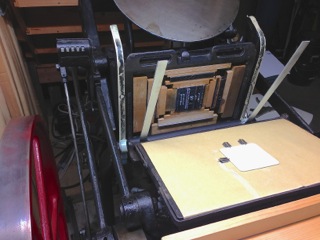
...placed on this hundred-year-old press and adjusted and tweaked  by Our Dedicated Printer...

…placed on this hundred-year-old press and adjusted and tweaked by Our Dedicated Printer…

The full set will be 8 coasters, each with a different haiku from the sequence. The front/top will have the haiku with a wave-like ornament, printed in a wonderful dark green. Emily hand-mixed this color using at least two different greens and black.

The back will have the sequence title, the place of the poem within the sequence, and the printer’s mark.

Emily has set type for five of the eight haiku, and printing will begin this weekend.

In letterpress printing, nothing is as simple as it seems. Even in printing the coaster’s back, Emily will have to stop printing eight different times, pull the type off the press, and adjust the sequence number on the back (see below for proof of what the back of the first coaster will look like).

...turns into this proof of the coaster's back. In the background is an actual coaster, undoubtedly anticipating its eventual transformation.

…turns into this proof of the coaster’s back. In the background is an actual coaster, undoubtedly anticipating its eventual transformation.

The typeface for the poems is Garamond Italic, and in the next post I’ll show a few proof samples of the haiku design.

Photo of the press courtesy of St Brigid Press

Poem for the last leaves…

leavesTwelve Bells

Twelve bells. Middle of the middle of October’s night.
Leaves hanging on. They want you to remember
The shade they have provided, the sweet field
They made in the summer sky.

But everybody wants them to look like they will
When they have forgotten everything but dying.

Now in the dark, in the middle of the stirring
Season they can briefly mark
At once what we miss and anticipate:
The green whisper outside the window

That softened the dream of the world’s first cold wind
And when we rise to shut the window

Staring outward in that moment we
Have not yet realized has woken us,
The hard shadow in the moonlit sky already
Edged with the skitter and curl they’ll make

In November’s brown doldrums
Crossing the street with a weightless curse, never to come back.

from Vanishing Tracks

Halloween-esque

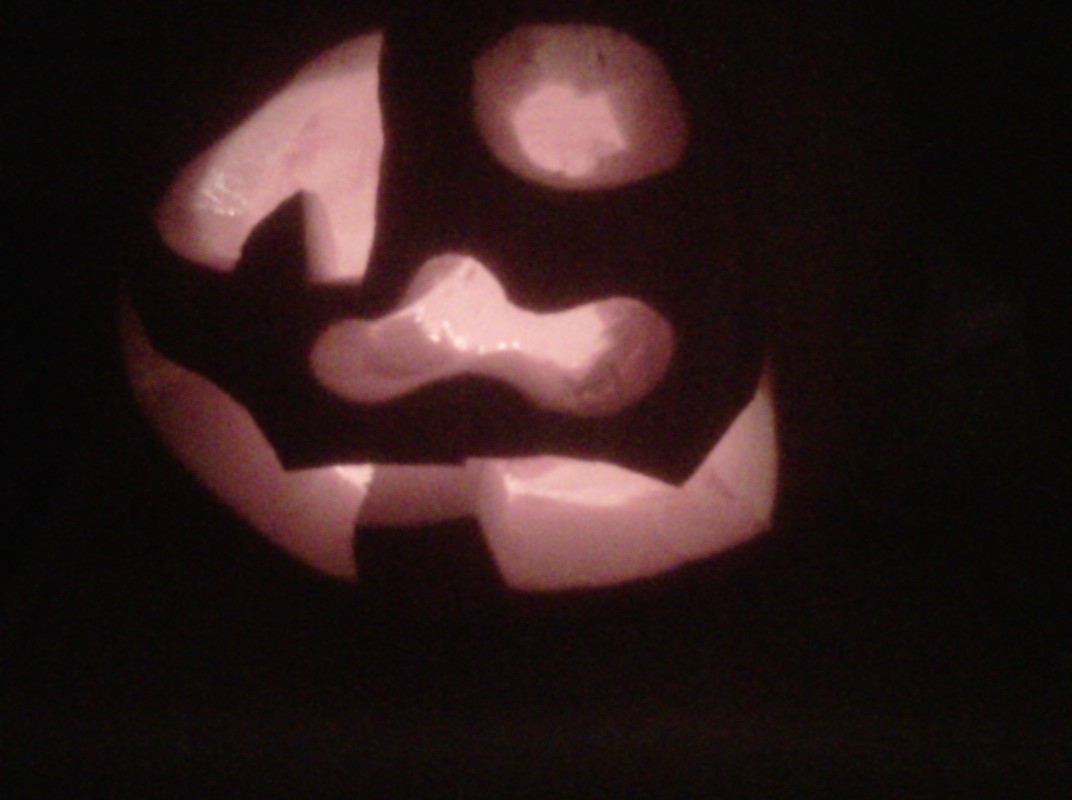
Halloween JackClosest thing I have to a Halloween poem…

Migration by Air

Daylight crawls up the highest steeple in town,
Jumps off. No one sees it fall or hears it land.

Just like yesterday, it left no note.

Walking up my hill, thinking about lost souls, mine
Among them, I look up. In the moon’s first quarter

The sky smiles with one curved tooth.
A few clouds hang over the gables like gauze.

Like a swarm of black non-sequiturs suddenly

Dozens of vultures sweep over the crest of the hill in front of me,
Covering the sky, some gliding, too large to fly but beating
Away common sense

With slow motion punches, close enough to the ground
That in this mid-autumn
Silence I can hear the engine of each heavy wingbeat whisper-chuff

Like some far-away locomotive with its freight of happy carrion.

At this hour everything turns the shade of barely missed opportunities,
Or a thing you forgot to say as the moment fades into the past.

The moment is gone, but the thing remains.
It’s still there, behind the dark.
By the next day it will be changed by even a single night yet utterly

Recognizable. This is why loss stays with us. Why all God’s numbered hairs

Stand on end when the last vulture pauses and circles
You before moving along,
Why we feed monsters candy. Because they see in the dark.

from The Artificial Horizon

Time to Read

Getting ready to head over to AVA for the reading at 7pm. I’m looking forward to meeting Jeffrey Condran, the fiction writer I’ll be sharing the stage with tonight. Today’s poetry reading weather–overcast, windy, leafy. And a moon waxing on full. Not so bad! Hope to see some of you over there in a few hours.

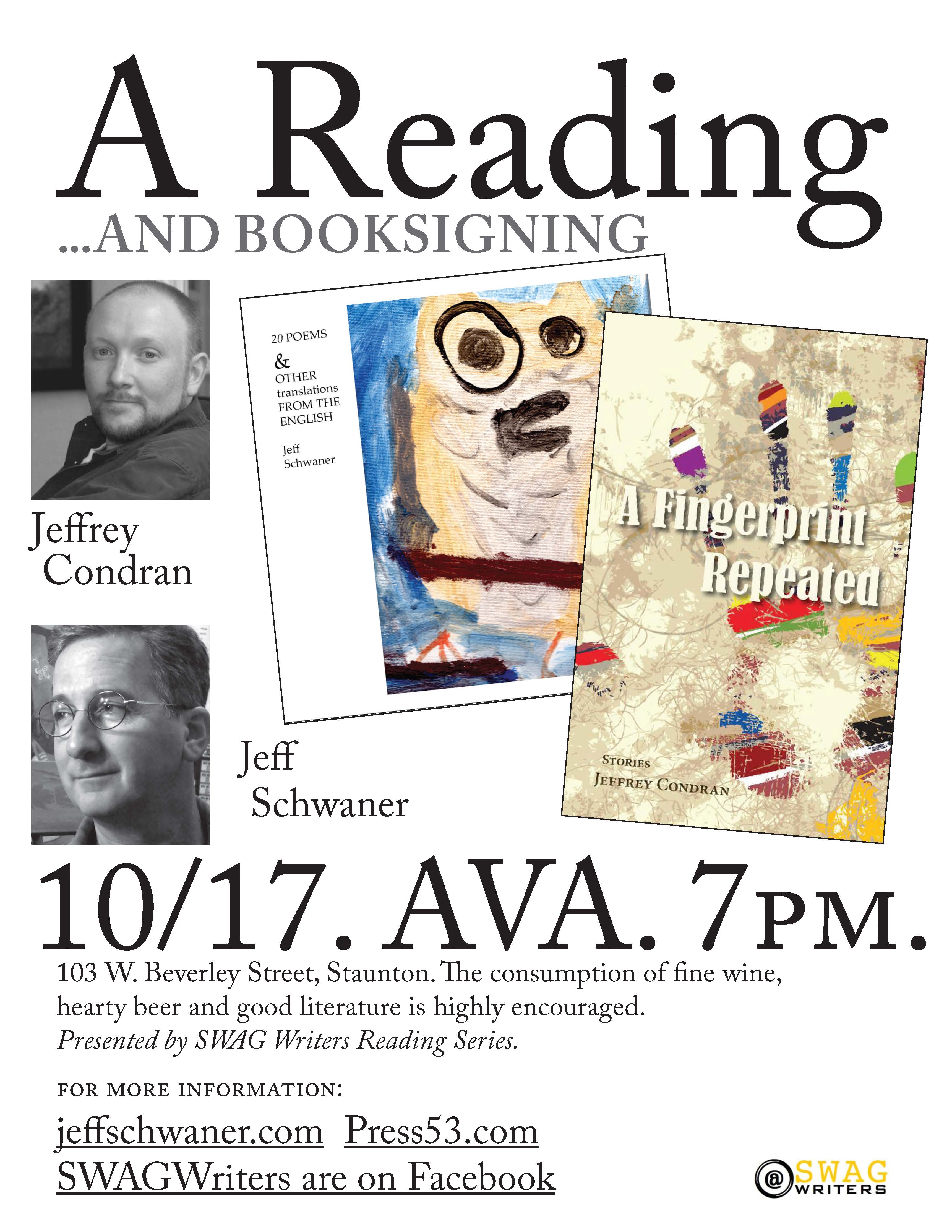
Poster for Reading!

10172013_POSTER_5final

I think I finally have the design finished for the poster for the October 17th reading with Jeffrey Condran. Cliff Garstang of SWAG has also done a nice color poster for the event.

Coming 10.17.2013: First public reading since, errrr, 1998?

Has it really been that long since I’ve read in public?

Yes and no. Mostly yes. I have read a few times this summer at monthly gatherings of Staunton’s local writer’s group, the Staunton Waynesboro Authors Group, at a wonderful wine bar downtown called AVA. Those readings consisted of an hour of socializing and drinking, followed by a shotgun procession of members reading for no longer than five minutes. I found it invigorating to read in front of this group of varied interests and styles, and was surprised and gratified to get invited to be part of this upcoming reading (also at AVA) with visiting author Jeffrey Condran, whose book of short stories A Fingerprint Repeated is being published in October by Press53.

Still trying to convince myself that the reading’s organizer, SWAG chief Clifford Garstang, did NOT pick me to read mainly on the basis of my first name. . .