Designing a (haiku) drink coaster, pt 2

Eight haiku. Twenty four total lines. A unique drink coaster printing project.  What’s the big deal?

Hundred-year old presses. Tiny pieces of metal type. Questions like, errr, do we have a ligatured ff instead of a regular ff? Did a piece of roman type slip into the italic type drawer? Did we just really run out of lowercase e’s?? And so on.

First poem in the haiku sequence. The ink is a rich dark green.

First poem in the haiku sequence. The ink is a rich dark green.

Here’s Emily’s design for the haiku side of the coaster, with a proof on regular paper placed on top of a coaster so you can see the approximate registration.

I like that the haiku has its own space, and that all the other information, including the title and sequence of the poems, is on the back. It gives the reader the experience of the poem alone.

And here’s a proof of the last poem in the sequence:

An old Marvel Comics-inspired No-Prize to anyone who spots the Boy I'm Glad We Proofed This detail.

An old Marvel Comics-inspired No-Prize to anyone who spots the Boy I’m Glad We Proofed This detail. Oh, wait. I’m out of No-Prizes. So just read the copy to the left.

I was so enamored with seeing my own work printed in beautiful Garamond that it took me over a dozen views before I noticed the “s” in the first line is a roman “s” and not an italic “s”. Now there’s a whole philosophical movement going back a couple-three generations among some printers that states you should leave some flaws in your work, because after all to err is human, and in some cases perfectly so. But in this case I decided that I’d just stick with fixing it and not get all philosophical.

That will be the reader’s job, upon the second or third drink…

Photos courtesy of St Brigid Press

Designing a (haiku) drink coaster, pt 1

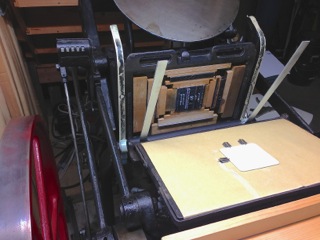
This jigsaw of metal type, wood and quoins (those locks that hold it tight)...

This jigsaw of metal type, wood and quoins (those locks that hold it tight)…

I met with Emily Hancock of St Brigid Press today to go over some designs and proofs of the “Night Walk on Cape Cod” haiku sequence. When you set metal type by hand, you cannot be cavalier with your design decisions! After years of using InDesign to design books, it was wild getting back into a workspace where each letter and every bit of “empty” space is actually a physical object to place so that the reader best navigates the printed page. (No Ctrl-Z here, sez he!)

...placed on this hundred-year-old press and adjusted and tweaked  by Our Dedicated Printer...

…placed on this hundred-year-old press and adjusted and tweaked by Our Dedicated Printer…

The full set will be 8 coasters, each with a different haiku from the sequence. The front/top will have the haiku with a wave-like ornament, printed in a wonderful dark green. Emily hand-mixed this color using at least two different greens and black.

The back will have the sequence title, the place of the poem within the sequence, and the printer’s mark.

Emily has set type for five of the eight haiku, and printing will begin this weekend.

In letterpress printing, nothing is as simple as it seems. Even in printing the coaster’s back, Emily will have to stop printing eight different times, pull the type off the press, and adjust the sequence number on the back (see below for proof of what the back of the first coaster will look like).

...turns into this proof of the coaster's back. In the background is an actual coaster, undoubtedly anticipating its eventual transformation.

…turns into this proof of the coaster’s back. In the background is an actual coaster, undoubtedly anticipating its eventual transformation.

The typeface for the poems is Garamond Italic, and in the next post I’ll show a few proof samples of the haiku design.

Photo of the press courtesy of St Brigid Press

Haiku + Drink + Fine Letterpress Publisher = Coaster Sequence??

NightWalkonCapeCod_prep1

At St Brigid Press, the table is set for design–and the type is set, as well, if you can read backwards.

I’m happy to announce that I’m working with Emily Hancock of St. Brigid Press to publish a haiku sequence entitled “Night Walk on Cape Cod” … in a very unique letterpress format.

Emily, whose work is featured in an article in Blue Ridge Life magazine, has done some great typographical work in books, posters, even a cool American Authors drink coaster series.

coastersdetailstbrigid

Samples of the “American Novelists Series” of letterpress drink coasters from St. Brigid Press.

Over the past few days Emily has begun designing a series of coasters which will comprise the eight-part haiku sequence “Night Walk on Cape Cod” from my book Vanishing Tracks. The set will be available soon here on the Translations site as well as at St Brigid Press.

Haiku on drink coasters? Would it be wrong of me to say that the combination strikes me as, well, intoxicating? (Okay, so it would be wrong. I just can’t seem to hit the backspace key, though.) Imagine lifting your favorite drink off the counter of your equally favorite drinking hole–even if that is your kitchen or den–and seeing the engimatic three line stanza that immediately identifies itself to you as a haiku, looking up at you invitingly as you take your first drink. Go ahead, read it. It doesn’t have to make sense. A few sips later, maybe some interpretive inspiration hits you, hmm, and next thing you know you are all zen with the world and entertaining your guests (or pets) with your newly found elucidation of things deep and mysterious. And like any literary treat, these coasters are reusable, and only get better with age, much like their content.

Should I go on? Great for book club meetings, most of which tend to involve some form of refreshing beverage! When you consider that the labors of writing and reading literature often drive a person to drink, it’s nice to be able to turn the tables on that equation and say that the enjoyment of drinking could potentially turn one to reading poetry…and appreciating fine printing.

I’ll have order information and some samples up on the site soon.

The print run will be limited so feel free to contact me if you would like to reserve a set. Opa!


Photos courtesy of St Brigid Press

Poem for the last leaves…

leavesTwelve Bells

Twelve bells. Middle of the middle of October’s night.
Leaves hanging on. They want you to remember
The shade they have provided, the sweet field
They made in the summer sky.

But everybody wants them to look like they will
When they have forgotten everything but dying.

Now in the dark, in the middle of the stirring
Season they can briefly mark
At once what we miss and anticipate:
The green whisper outside the window

That softened the dream of the world’s first cold wind
And when we rise to shut the window

Staring outward in that moment we
Have not yet realized has woken us,
The hard shadow in the moonlit sky already
Edged with the skitter and curl they’ll make

In November’s brown doldrums
Crossing the street with a weightless curse, never to come back.

from Vanishing Tracks

Halloween-esque

Halloween JackClosest thing I have to a Halloween poem…

Migration by Air

Daylight crawls up the highest steeple in town,
Jumps off. No one sees it fall or hears it land.

Just like yesterday, it left no note.

Walking up my hill, thinking about lost souls, mine
Among them, I look up. In the moon’s first quarter

The sky smiles with one curved tooth.
A few clouds hang over the gables like gauze.

Like a swarm of black non-sequiturs suddenly

Dozens of vultures sweep over the crest of the hill in front of me,
Covering the sky, some gliding, too large to fly but beating
Away common sense

With slow motion punches, close enough to the ground
That in this mid-autumn
Silence I can hear the engine of each heavy wingbeat whisper-chuff

Like some far-away locomotive with its freight of happy carrion.

At this hour everything turns the shade of barely missed opportunities,
Or a thing you forgot to say as the moment fades into the past.

The moment is gone, but the thing remains.
It’s still there, behind the dark.
By the next day it will be changed by even a single night yet utterly

Recognizable. This is why loss stays with us. Why all God’s numbered hairs

Stand on end when the last vulture pauses and circles
You before moving along,
Why we feed monsters candy. Because they see in the dark.

from The Artificial Horizon

Collecting the Uncollected

I’ve added a new section to the site called “Uncollected.” It’s a place where I’ll be posting the occasional work from recent years which has not found its way into my four books. Included will be excerpts from a book-length sequence of poems based on Helen Frankenthaler’s paintings (and also on my grandmother Helen’s life) called–okay, you guessed it–“Helen.”

The piece I posted today is from a trip to Folly Beach near Charleston, South Carolina a few years ago.

Do What You Wanna Do, Do What You Can (Lou Reed)

loureed


And something flickered for a minute
then it vanished and was gone

I will sure miss you, Lou Reed.

Something to remember him by, playing alongside another of my favorite singer/songwriters, Elvis Costello.

Favorite Poets: Tomas Transtromer

One in a series of posts about my favorite poets or books of poems.

The cover of Selected Poems, circa 1989.

The cover of Selected Poems, circa 1989.

Back in 1996, I wrote an appreciative piece about Tomas Transtromer in a monthly literary scandal rag called Captain Kidd Monthly, which my wife and I published while living in Charleston, South Carolina. We had a regular column called “Davey Jones’s Locker” where we or a guest editor would extoll the virtues of a great writer or work which we felt was under-appreciated. Here’s what I wrote back then:

Every time I open Tomas Transtromer’s Selected Poems–the only book of his verse available in America right now–I get the creepy feeling that I’m looking at the inner walls of my brain through the eyes of someone who knows it all better than I do. I forget all my favorite poets, and find myself exclaiming to folks who I know don’t even read poetry, “Hey, you! Read this! This guy is the greatest living poet today!”

Open this book like the I Ching, to any page, and you’ll find your world transformed. I’ll do it right now for you–

A FEW MINUTES

The squat pine in the swamp holds up its crown: a dark rag.
But what you see is nothing
compared to the roots, the widespread, secretly creeping, immortal or half-mortal
root system.

I you she he also branch out.
Outside what one wills.
Outside the Metropolis.

A shower falls out of the milk-white summer sky.
It feels as if my five senses were linked to another creature
which moves stubbornly
as the brightly clad runners in a stadium where the darkness streams down.

The first line in his book–“Awakening is a parachute jump from the dream”–sets the stage for a career of perfectly realized poetry. Even in a volume translated by several hands (and edited ably by Robert Hass) the singular volice is unerring and clear. From his poem “Answers to Letters”:

Was the letter ever answered? I don’t remember, it was long ago. The countless thresholds of the sea went on migrating. The heart went on leaping from second to second like the toad in the wet grass of an August night.

Transtromer finds the seams and cracks between disparate segments of experience and follows them to the inner swirl of mind that both covers and uncovers meaning–

In the day’s first hours consciousness can own the world
like a hand enclosing a sun-warm stone.
The skydiver stands under a tree.
With the plunge through death’s vortex
will light’s great chute spread over his head?

Back in 1996 I actually bought ten copies of Selected Poems and gave them away to interested customers at Chapter Two Bookstore where I worked, as kind of an act of thanksgiving to celebrate a new edition of of the book, first published in 1986.  Since then, Scottish poet and translator Robin Fulton has come out with the most comprehensive edition of Transtromer’s published work. Hass’s edition is still in print, and Robert Bly has at least one volume of translations of Transtromer in print as well. You can check them out here. Fulton’s translations have become my favorite, and that volume (entitled The Great Enigma)  includes his short autobiographical piece “Memories Look at Me” as well. But Transtromer survives practically any translation, one of the many things I find magical about his work.

When my wife and I look at art or photographs, we often use the phrase “I can imagine living with that” about stuff we like. It’s not a comment on art-as-furniture; it’s more of a feeling that you establish a relationship with art you like, and that relationship grows and changes over time, and the art that lasts is the stuff that worked for you twenty years ago and ten years ago and still works for you today, even if it works in a different way. We have the same complex relationship with the work of our favorite poets. I titled this post “Favorite Poets” but I could also call it “Poets I Live With” because from the moment I first picked up one of his books in the library in 1989 I have been living with Tomas Transtromer’s work, growing with it and appreciating it.

Read more about Transtromer at his official site

.

Another of the tribe’s customs

Well the reading last night was very nice and well-attended. A lot of the folks from the local writers group were there, and I’m grateful for the turn-out from friends and readers, many of whom I know already had long days behind them (and, in two cases, birthday celebrations ahead of them!) and still took the time to show up. It made the event very meaningful. I’m also grateful for the readers from outside the Greater Staunton Metropolitan Area (you know who you are) who showed me support leading up to the reading.

I opened the reading with a passage from a story by Jorge Luis Borges, which I had just stumbled across earlier in the week. It describes a Scottish missionary’s discovery of a tribe of previously unknown people:

Another of the tribe’s customs is the discovery of poets. Six or seven words, generally enigmatic, may come to a man’s mind. He cannot contain himself and shouts them out, standing in the center of a circle formed by the witch doctors and the common people, who are stretched out on the ground. If the poem does not stir them, nothing comes to pass, but if the poet’s words strike them they all draw away from him, without a sound, under the command of a holy dread. Feeling then that the spirit has touched him, nobody, not even his own mother, will either speak to him or cast a glance at him. Now he is a man no longer but a god, and anyone has the license to kill him. The poet, if he has his wits about him, seeks refuge in the sand-dunes of the North.

Now I remember why I hadn’t read in public for 15 years!

Another thing that I realized I had not done in a long time, in fact that I had never done, was to stand around and sell my own books. I can’t count how many book signings and readings I’ve been to, especially in my ten years as a bookseller and for a few years helping to pitch other self-published authors’ books at book festivals in Virginia, Arizona and New York. But as I stood behind this bar at AVA after the reading, dishing out books like mixed drinks and glasses of wine, I suddenly realized that I had never been in this position before, and that probably accounted for most of my anxiety leading up to this event. It’s one thing to read your work and share it with an interested (or even disinterested, in the case of a few diners last night) and decidedly not hostile crowd; it’s a whole ‘nother thing to then put a price tag on your work and (literally) stand behind it at the point of purchase.

It was also a gratifying thing. The other writer, Jeffrey Condran, and I exchanged copies of our own books, and enough people came up and bought books that two positive things came out of that–I became comfortable with the necessary idea that one has to sometimes put a retail price in front of one’s meaningful work; and, because of that and with the booty from a few sales, I was able to enjoy a trip to the local ice cream shop with the family directly afterwards (and a lunch at our favorite Indian restaurant today) in a celebration supported by those sales.

So really the biggest thing I learned last night, in a very personal way, was that another of the tribe’s customs seems to be that the tribe comes, the tribe listens, and the tribe buys poetry books. That’s a pretty decent tribe to belong to. 

Lastly, just a pitch for the “other Jeff,” Jeffrey Condran. Jeff read a story titled “Praha” from his newly-published collection which was really great–complex, quiet, a little unsettling, just right. As soon as I got home and we got the kids to bed, I pulled out his book and started in on the second story, “Irregulars.” His work is definitely worth checking out, and you can find this book at the website for his publisher, Press 53.

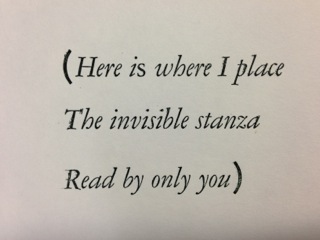
Time to Read

Getting ready to head over to AVA for the reading at 7pm. I’m looking forward to meeting Jeffrey Condran, the fiction writer I’ll be sharing the stage with tonight. Today’s poetry reading weather–overcast, windy, leafy. And a moon waxing on full. Not so bad! Hope to see some of you over there in a few hours.