To An Old Tune

To An Old Tune


Always a surprise to hear your voice
and realize you are still with me

I must persist in you and grow less quiet
now and then like a song that comes to mind

or maybe like the years hum a little louder
without recognition above the level of crickets

distant trains garbage trucks or maybe you have
loved me this long and I’m still surprised by that

[readings] Thank you, Li Ho (and Edward Scott)

Thank you, Li Ho: [Reading 3/8/2014 at Allen Chapel AME Church in Staunton VA as part of “Rhythmic Time Between the Lines”]

Today I spent a few hours just a few blocks from my house, in a part of the world that was almost entirely foreign to me, and by bringing in a piece of work that was equally foreign I believe I helped contribute to something meaningful. Or maybe I should say that I believe that Chinese poet Li Ho (b.790) contributed–but I brought that guy with me, after all…

I was invited to participate as a member of the local writers group in a fundraiser to celebrate 21 years of the Allen Chapel AME Choir. Also there to read or perform in this small brick church said to be the oldest church established by people of color west of the Blue Ridge mountains were a handful of other poets, dancers, singers, students, and even a talented mime.

After a couple of dancers and a few poets whose work seemed pretty in tune with the occasion and the religious nature of the setting, I introduced the congregation to my old friend Li Ho. I talked about Chinese poets of the 8th and 9th centuries and how many of the things they wrote about–mountains, snow, sky–were important elements of our lives in this town. I then read the prose poem “On Translating Poetry from the Chinese” and after that read my recent translations of poems by Li Ho and Li Po.

I can tell you that in a AME church setting, people behave like they are in church. That means if they hear something they like, you know it before you’re done reading that line.

“Mm-hm,” someone says quietly. “Uh yeah!” says another voice, a little louder.

I wasn’t reading poems about God, I wasn’t giving an uproarious rendition of a Nikki Giovanni poem, I was not preaching to the choir (no pun intended)—I was bringing to this room some words and ideas that were utterly foreign to those in attendance. And they immediately got it. And I believe the reason they got it was because they were open to it and they were actively listening. That’s what they came there to do every weekend, and that’s what they were doing now–listening and responding, line by line, it seemed, to the words of a man born in 790 CE, and another born in 701 CE. For the poet born in 1965, the enthusiastic applause for each of the three poems I read was not just polite–it was part of the celebration. It was a celebration of being there, and being alive, and listening.


Later, in his closing remarks, the church’s pastor Rev. Dr. Edward Scott was speaking quietly and personally about a recent tragedy that rocked this church community, that being the death of his daughter just a few weeks ago. He was talking about suffering, the intense suffering of the dying, the grieving of the survivors, and how upon his return from Raleigh he did not at first wish to return to church, or see or talk to anyone; but how he put on his tie and shirt and shiny shoes and came to church today to listen. “And today,” he suddenly boomed in a style which I am sure was quite familiar to his congregation, “I heard tell of a TOAD on the MOON!”

He intuitively had grasped that ancient symbol, that distant watcher, as a way to connect us in that meeting hall to a Malaysia Airlines plane crash that had just happened that day–how beneath that moon was more suffering that must be met, more survivors in far-away places that must come home to grieve and be supported by their communities.  He instinctively grasped the moon as elemental to identifying with missing and missed loved ones, just as Li Po and Li Ho did in their time. He found his own grief instructive, channeling it through twelve lines of verse written twelve hundred years ago and everything else he’d seen and heard that hour, into a vision of a shared world.

Suddenly I didn’t feel like my contribution to this celebration was quite so foreign, after all.  And for that I can thank two Chinese poets I have never met, and one newly-met pastor of an America I’m still discovering.
 

Early March, Above Freezing, Light Snow

Early March, Above Freezing, Light Snow


Five mourning doves gather on close branches.
But the sky in the trees is too miserable for mourning.

Even the earth will not accept the night’s snow
which sits in clumps on the ground like oil on water.

It highlights fallen trees on the mountain slope
showing all the directions down can take you.

Between the shed and a crack in the clouds
two bluejays mate in a flurry on a fallen ladder.

Weakness

Weakness


At night when my heart sets out to find you
my weakness follows clumsily waving a lamp
behind me casting shadows making still things
seem to move and moving things
impossible to identify: I don’t spend much time
with my weakness but it finds me easily enough
I don’t talk much about it or even look at it
straight on though when it speaks its volumes
increase when it is seen it is familiar
I know I cannot shake this thing which is not a thing
but like the part of our bodies we cannot see
When I see that part through others it wears my face

[publications] New Orleans Review

In a happy coincidence, I found out Sunday that a few of my poems not featured on this site will appear in the New Orleans Review.

It’s happy because outside of some bouts of very active self-publishing (including starting a self-publishing print-on-demand company in 2000) I have not had a poem appear in a non-local journal or magazine for something like 27 years.

It’s a coincidence because that last time a poem of mine was published outside of my local sphere, it was by a magazine in New Orleans as well, one called Fat Tuesday. And also coincidental because, well, it’s that Fat Tuesday time of year. Hmm… (Cue Robert Stack in trenchcoat…) What is it with New Orleans?

NOR not only has a great print journal but also ever-changing web features, including a page for poetry.

The Left Lane

The Left Lane

Sometimes the present is the bird of prey: on the long morning highway towards work, I see half a mile ahead of me a steady migration of cars from the left lane to the right. This often happens when a driver becomes preoccupied with something other than driving; there’s an equation somewhere for this coefficient of attention and the resulting diminished pressure on the one’s acceleration across this moment of paved lane, and the next thing you know there are cars streaming by to the right, some drivers keeping their eyes straight ahead knowing that they are breaking road protocol by passing on the right, some pausing to stare at the offending driver before gunning past them. Because on a two-lane road winding through the foothills and with as many trucks as vultures settling on the occasional and equally inattentive deer, such behavior is considered rude and is answered in kind, namely by this stream of cars passing on the right while the offender is trapped in the wrong lane, unable to adjust their location to the speed they are going, while a long line of angry and virtually late commuters drifts by. Because to the one being passed, it’s not like someone going eighty miles an hour, it’s like people walking by you who are simply walking faster than you and have no idea why you are walking so slowly. It takes time to be passed when trapped in the left lane.  This morning (though who knows what morning it will be when you read this, maybe one in which you have sped by someone yourself) I follow my basic rules of the road—never be the fastest or slowest on the road, never give the person behind you a chance to ruin your day, never do the same the person in front of you. From the left lane I stay in queue and glide into the right lane behind the car ahead of me, and pass this slow car like every other vehicle is doing. In that comfortable slipstream I glance back into my side rear-view and for just an instant see the distraught expression of the driver—she is old, she is driving a little over the speed limit, she is caught in this pocket of wrong lane by things happening too fast for her to keep up with, and by people who will not let her move over. She’s not doing anything wrong! All this I read in a half-second’s reflection through a windshield coated with morning sun’s glare.  I feel like it is her mind that is glaring off the windshield, not the sun. It is blinding in its clarity.  I want to take my foot off the pedal, let her pass me and take up a position back in the left lane, behind her car, to shield her from the assault of everyone trying to get to the future faster. Is this not the trip my own mother takes each day, alone in a vessel already traveling too fast but not fast enough to catch up to the past or avoid the future? But it’s too late, the driver in a pickup truck behind me is already pushing me forward, and the car behind him, so I tap on the pedal to speed up further, and when I look back again the windshield is dark in the diminishing image in my mirror. And I’m no mind-reader; I’m just another driver passing by, part of the unremitting assault of the present.

Early Signs

Early Signs


All at once dogs and children roam in friendly agitation
where yesterday they stuck to the plowed paths

They climb the mountain of last week’s snow pushed to the roadside
Its ten thousand questions answered

by the lengthening silence of the afternoon
I feel like calling you every hour just to say nothing special

With thunder and warm wind spring starts to shoulder winter aside
Under sky’s sharp azure stone a jeweled cloud leapfrogs mountain

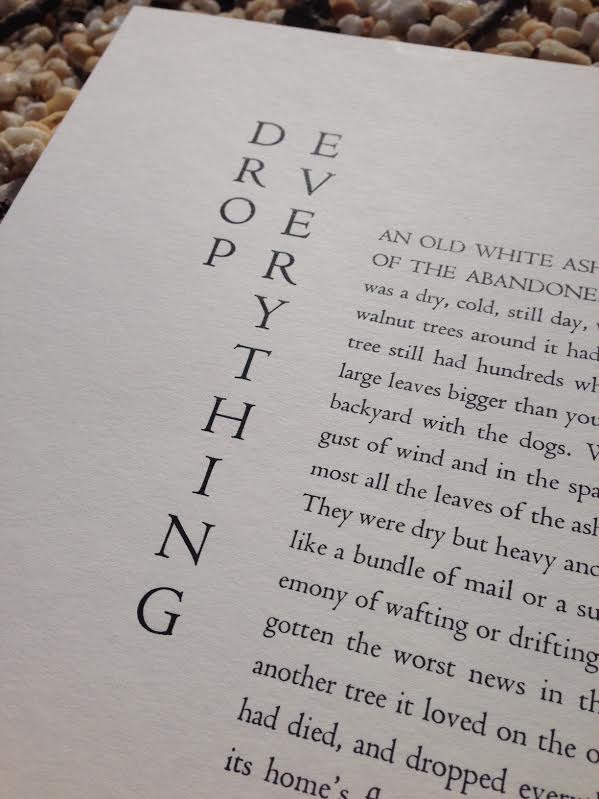
2014 Broadside Series: “Drop Everything” (first proofs)

Some shots of first proof off the press. (All photos below were taken by Emily Hancock of St Brigid Press, as she was doing first proofs.) This is on the bamboo paper.

DE_title proofAnd here’s a look at the entire shape of the broadside…

DE_first proof on bamboo2We’re still deciding what the best paper might be.  Emily ran some proofs on other stock and we’re going to go over them with our magnifying glasses and every nerve of our fingertips to see which looks and feels the best. The typeface is 18 pt Centaur, so the paper has to take the ink from a decent size letter while holding to the fine points and handling ligatures.

DE_proof on four papersOf course, it’s impossible to tell the fine differences in these examples without holding them and eyeballing them first-hand. What the heck good is this internet thing anyway if you still have to hoof it over a mountain to see your proofs? (Though there’s always offering free coffee to your printer to get her to come over the mountain to you…)

More later this weekend…


Sending Snow to My Friend L in Turkey Before Rain Washes It Away Or It Melts in Delivery

Sending Snow to My Friend L in Turkey Before Rain Washes It Away Or It Melts in Delivery


There is the right way
[insert memory here, L]:
(there is this way, too)

Western Haiku Instruction Manual, two lines of which are cribbed from Google Translate’s English version of Indigenous Metropolitan’s Post “Social Studies (Unpretentious) To Write A Haiku” Originally in Italian [haiku]

Western Haiku Instruction Manual, two lines of which are cribbed from Google Translate’s English version of Indigenous Metropolitan’s Post “Social Studies (Unpretentious) To Write A Haiku” Originally in Italian


A fair game of balance:
(do not respect the syllables)
a life is in your hands


See Indigenous Metropolitan’s original post here.