Getting the Full Moon Social going multi-media style…
Full Moon Social – Upon Waking, I Remember
Leave a reply
Getting the Full Moon Social going multi-media style…
Any enclosed space is a temple. While we turned away
the sky came down and delivered news of the moon,
it hangs there just above the trees, a white ceiling
glowing from the light of streetlamps below, it waits
folded like a newspaper delivered but not yet read,
thicker and more important seeming than it will be
when it’s picked through and thinned out
and in some cases like my dad used to do tied in knots
and thrown in the fireplace with kindling where
burning it rises through the cloud’s cold floor
and brings news of the hidden world to the new
moon in its temple of absence
Note: My 11 year old daughter Sophia wrote this poem earlier this evening.
Swooping down the sky
reaching what grasp cannot
through chiseled spaces
of interlocking earths
Gone to the time’s end
old darkest wrinkles
Voracious sounds of sight
always forward looking
What is never is now appearing
foretold futures swaying
on lines of pure balance.
Grains of gold including the factor
deepening eyes of she did swell up.
Raining waterfalls that did
forever secrets handling.
Emily Hancock of St Brigid Press, publisher of a few beautiful letterpress editions of works by This Here Poet, is releasing a new book this week entitled “Soundings.” The book consists of haiku and illustrations by Emily, the Founder of SBP. Check out the SBP site for more pics and info about the process. /JS
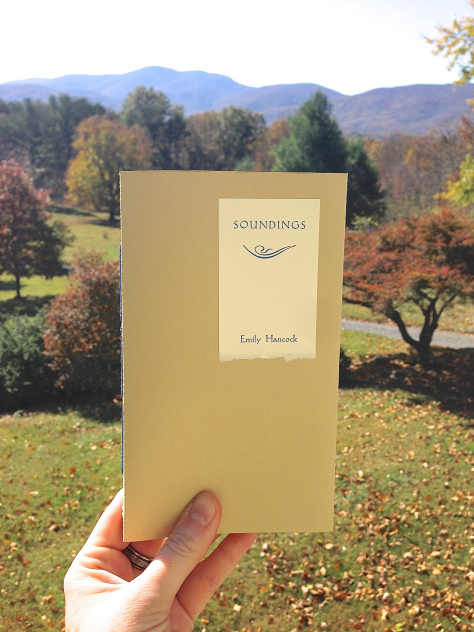
We are pleased to announce the publication of Soundings, a new book of haiku by Emily Hancock. Inspired by the beauty of the Blue Ridge Mountains, where Hancock makes her home, this lovely book collects over 30 of her poems and 3 original linoleum block prints.
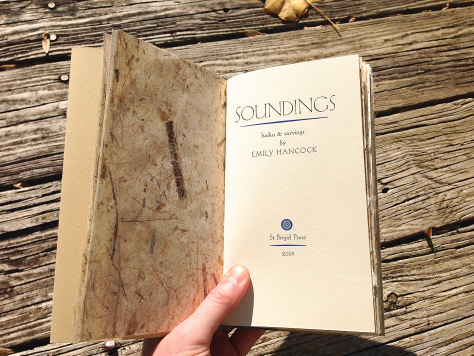 The title page of Soundings, on cream-colored Rives paper, with banana-leaf decorative paper facing.
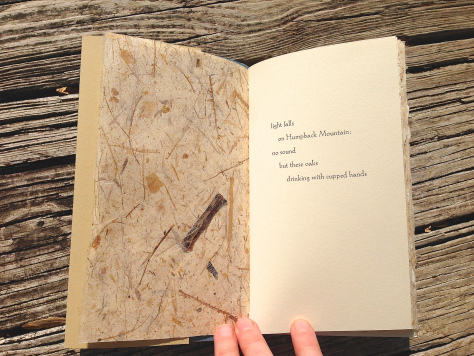 One of 33 haiku by Emily Hancock, collected here for the first time.
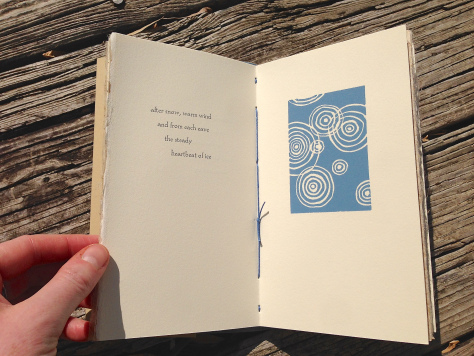 One of 3 three illustrations printed from original linoleum block carvings by the author.
Designed, hand-set, letterpress printed, and hand-sewn here at the Press in a limited edition of 85 books. Pre-order a copy HERE; books will be shipped on November 10th.
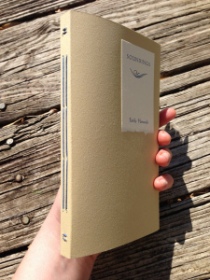 Each book is hand-sewn with linen thread.
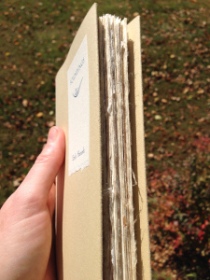 Live text block fore edges.
If you are in the area, please join us for the official Book Launch Reception and Signing ~ this Friday…
View original post 123 more words
The Night Before
Is it the night you decide to save your own life
or whether to save your own life
The night after the three page do-not-resuscitate note
they found on your hotel bed in the morning though you were
found there with it, smoking, complaining, in the room your father
paid for, not wanting to abandon you as the hospital had,
as you feel the whole world had. In your deepest misery
you could not abandon yourself, though your note
claimed death was better than being alive. It is not
the first such note but the first in a while, and
begs the question, why were you both there
this morning when we arrived? You wanted
both to be found. You wanted your death to be found
and your life to be saved without engaging either
of them. On my desk tonight I open
an envelope I have had for three dozen years. It’s filled
with cancelled stamps from around the world, from places
you and I will never visit. Chad, Posta Romana, Dahomey.
Magyar Posta. Ceskoslovensko, some countries
that no longer exist, no more than the messages
whose freight these stamps once paid. One stamp depicts
only another stamp from thirteen years earlier.
Thirteen years earlier would you have believed
you’d be here, in a hotel you can’t pay for,
To make a decision you think someone else
should make for you. You are more
Than what you have paid in pain to be
transported here. More than a value a black mark can cancel
but you are not something that can be opened and read.
You are the author of the note demanding you not be saved.
You cannot be reached by phone. Or any other method
save a mark on tomorrow you have not yet made.
I saw some mock-ups and page proofs of this book yesterday. It is going to be a great book to read, and a great book just to hold in the hands. Emily, you should write an entire post just about the typeface and how you managed to acquire it from Herr WhateverHisNameIs in Germany, via bilingual intermediary and (I think) time travel.
 The season is bearing fruit here in the Blue Ridge mountains…
Autumn Greetings, Friends!
We are pleased to announce a new book forthcoming from St Brigid Press in November: Soundings, a collection of haiku by Emily Hancock, illustrated with three prints by the author.
Hancock has been published in various literary journals, including the Appalachian Journal and the Greensboro Review. This limited edition book will collect over thirty of her haiku, each a small meditation on being in nature and the nature of being, as well as three prints from her original block carvings.
 Setting the poems by hand.
 Carving images into linoleum blocks, which will then be printed.
All of the type is set by hand (in the historic Koch-Antiqua typeface), letterpress printed on beautiful Rives mould-made paper, and sewn with linen thread.
 Rives paper, mould-made in France.
SAVE THE DATE!!! The official Book Launch for
View original post 102 more words
Here’s how this game of poet’s tag works: I will introduce you to three writers (really four, but that’s a footnote to a complication to an exception to a rule I did not read) whose work I admire. I will then answer four questions about the writing process. I will do my best with the answers, but the reason I took up the challenge to do this process blog hop was really to talk about the poets below. The “tag” is that these fine poets will have to do a post of their own like this in a few weeks. But enough logistics! Here are the poets!
 Leonard Durso is a native New Yorker, once owned a literary bookstore in Los Angeles, ran English language programs in New York and Istanbul and once, in a city far, far away, was a scoutmaster, which means he’s pretty good at tying knots, building campfires, finding his way out of the woods, and is also loyal, trustworthy, helpful, etc.
I’ve been following Len’s site since I first started this blog a little less than a year ago. Leonard regularly posts a stimulating combo of his own poetry and poets who’ve inspired him. When I saw his post of the work of a T’ang dynasty poet, I knew I had met a kindred spirit. He is my go-to guy for the heart of the matter, and his style is reminiscent of certain Beat and New York school poets like O’Hara and Koch, whose work is characterized by honesty, modesty, and the wisdom of experience, all set through a sieve that has worked out the needless and ornamental till there’s only pure strain of thought left in the tumbler. Leonard’s biographical statement reads that he’s good at tying knots; as a poet he’s also good at untying them, or at least escaping from them.
I’m not trying to hint at Leonard’s age here (though he’s the only poet in this group with more gray hair than me), but at a certain period in one’s life as a writer one stops trying to build fine-mesh butterfly nets that capture every flying thing, and instead turns to building kites. This is just one of the areas in which I am constantly the scout and Len the scoutmaster. And in his poetry and his other posts he really is helpful and trustworthy and has helped me find my way out of the theoretical woods more than once.
A famous passage from Chuang Tzu (translated here by Burton Watson) goes like this: “Words exist because of meaning; once you’ve gotten the meaning, you can forget the words. Where can I find a man who has forgotten words so I can have a word with him?” Chuang Tzu, you just need to meet Leonard. And dear Reader, so do you.
 Dana Guthrie Martin lives in the Kansas City area with her husband and their beloved Chihuahua. Her work has appeared in numerous journals, including Barrow Street, Boxcar Poetry Review, Failbetter, Fence, Knockout Literary Magazine, andVinyl Poetry. Her chapbooks include In the Space Where I Was (Hyacinth Girl Press, 2012), Toward What Is Awful (YesYes Books, 2012), and The Spare Room (Blood Pudding Press, 2009). She was a finalist in the 2013 New South Writing Contest, judged by Marilyn Kallet, and a semi-finalist in the 2013 River Styx International Poetry Contest, judged by Terrance Hayes. As of last year, Martin stopped seeking publication for her work and is instead sharing it exclusively on her site, This Life, Designed, where she is currently sharing new work, as well as serializing a full-length collection titled No Sea Here.
In March of 2014, Martin was diagnosed with a rare genetic immune deficiency called common variable immunodeficiency, also known as CVID. She recently took on the role of research ambassador for Patients Like Me, an online data-sharing platform and social network for those with medical conditions. Martin also serves as founding editor of Cascadia Review, an online poetry journal dedicated to showcasing the work of poets in the Cascadia bioregion.
Powerful and immediate, Dana’s work is often direct and penetrating rhetorically but the language of her poems does not shy away from a more elusive complexity, depth and rhythm and texture and the non-linear shapes of experience. You will find lines and thoughts that are disturbing, challenging and beautiful, sometimes all at the same time.
I feel lucky every time I get to read one of Dana’s poems, like I’m witnessing something important, elemental and integral to the world, emerging in its full maturity but still in its brand-newness. And that’s a bit humbling and energizing. Please visit her site and check out poems like “Breathe,” “Testimony,” “Praying Mantis” and see what I mean.

Michele. Or, her feet, at any rate.
I first came across the sofreudian site because I regularly check out the #haiku feed on WordPress. Among the seemingly thousand new haiku that show up each day, one writer’s work, jarring at first, kept sticking with me. The site is actually maintained by two writers, Michele and Kiki, a dynamic duo of sharp wit, innuendo, social commentary, pop culture reference, and sometimes just plain dirty language—it’s funny that it takes far more than seventeen syllables to even begin to describe what you will find in the haiku on this site. Poems that read like dialogue from a 1970s-era unevenly dubbed martial arts film, complete with dashes jammed in at just the parts where the translation goes awry—or changes directions—ha, your problem with translation, not mine busta!

Kiki. Clearly not a Patriots fan.
It was this ability to play with surface gestures and then drop into the abyss without warning that first hooked me, as well as this feeling that I was actually reading a translation of some kind, of my own ignorance at times. Michele’s poems regularly eviscerate the more mundane aspects of existence, vaporize fake chumminess, and yes, detach entire armies of sharks-with-laser-beams-mounted-on-their-heads against the pious and preoccupied. Then, without warning—and sometimes even without the standard-bearing em-dash—comes a beautifully searing line of pure longing. Call it the Beatrix Kiddo Syndrome, but the combo is hard to pull off—kiss your baby goodnight then go out and fight a duel to the death. Oh, and win. Most people cannot do this. Michele can.

Moscow mule, in proper Copper.
Sans authenticated biographical material, I can tell you this much about Michele, the main contributor to the site—she went to college in California and still lives there. She does design and editorial work for authors outside of a demanding professional design job. She’s an Aquarius, likes sour cherry jelly bellies, and her favorite drink is a Moscow mule ONLY if a copper mug is available. (Without a copper mug, it’s a greyhound.) She maintains a fairly eclectic reading list and writes reviews for goodreads. And she was once the Queen of the Swallows Parade in San Juan Capistrano, CA. I believe that day was an important one for her—wearing the crown, being carried by her Swallows Parade court contingent, and overseeing the blossoming buzzsaw of a sky full of tiny road warriors returning home, maybe she saw those birds turn into words, felt the freedom of the small soarer, and decided to write haiku. Oh, and to keep the crown while she was at it.
Regarding Kiki, and quoting an un-named source: Kiki has skills as a ninja, lawn mowing, pie eating, and she loves to hide in a closet after posting her haiku. Again, the author of this post does not claim to have verified any of these details. But you may verify the authenticity of the poems themselves by visiting sofreudian.com …before the swallows return.
I’m pretty sure this is the longest blog post I have ever written. So let’s keep going! Below are the questions about process, and my answers:
What am I working on?
 For the past seven months I’ve been at work on a project called The Drift. In a nutshell, here’s the backstory:
1. For Christmas my wife gave me a translation of one of the earliest anthologies of Chinese poems, most dating back to the T’ang and Sung dynasties– Poems of the Masters, translated by Red Pine. Originally the anthology was ordered by its subject matter–twelve or thirteen categories that might seem somewhat odd to the modern reader, including trees, insects, public occasions, seasons, etc. A few hundred years later the contents were reorganized into four sections– the four main styles of “regulated verse” in which the poems were written, with the poems placed in chronological order within those forms. It is in this format that the Red Pine translation is set out. As I read through it, I wondered how different the experience of encountering these poems might have been in the original anthologist’s order.
2. Over the course of this year I’ve written poetry in what I call “unregulated verse,” not attempting in any technical way to adhere to the original forms of regulated verse, but to choose a few formal elements (writing in couplets, writing mostly poems of either 4 or 8 lines but some up to 32 lines long) and themes to investigate, symbols to use, and stick to those. These poems are being published as blog posts in pretty much chronological order, but will also fall into specific categories. The idea is to have a book at the end of the year in which, by virtue of multiple formats, or via an app, or simply through the use of tags on WordPress, the poems can be seen in more than one order of content, and the interplay of the difference of order may create some additional contexts and meaning around and between the subjects of the poems. I haven’t begun investigating the functional requirements of this for the final publication; if anyone knows a great epub functionality or app that can do this, please let me know. I’m not talking about a book that shuffles its contents; but rather one in which the contents drift contextually or chronologically, like our own lives’ experiences and memories, providing a different sense of things.
3. Mei Yao-ch’en. My edition of Poems of the Masters contains a visually pleasing format–all poems appear on the right-facing page in English; on the left-facing page is the poem in its original Traditional Chinese characters, as well as a brief bio of the poet, discussion of the traditional symbols in use in that poem, and other contextual background, provided by the translator. For a somewhat equivalent or parallel effect, I have brought into the future as my traveling companion the Sung dynasty poet Mei Yao-ch’en, and am in the midst of a series of poems in which Mei, transported rudely from the 11th century to the present day at roughly my age, stays with me through four seasons as my house guest and writes poems about his experience of this world. These Mei poems will appear on left-facing pages, along with some prose poems, which hopefully will add a narrative and personable dimension to the more static meditations in my homespun “unregulated verse.”
4. The Drift… the theme of the drift, or of drifting, is examined throughout these poems. The drift of memory, the drift of time, the drifting of friendships, love, loss, the change in feeling that a drift in context can produce, and so on. As well as the basic idea of, well, getting the drift of something.
How does my work differ from others of its genre?
Uhh, I don’t know anyone else crazy enough to try to write the book described above? Does that work as an answer?
Why do I write what I do?
Taking my cue from my teacher A.R. Ammons, I’ve always operated under the idea that a poem is a walk. For Archie, a walk was the basic perambulation with the stuff of the world, the interaction with the elements and experience, sky and mind, necessary to write. Writing a poem is taking a walk in my mind, amid the driftwood of the day. It’s a way of figuring out where I stand in relation to the world.
How does my writing process work?
I always have a piece of paper in my back pocket, and a pen. I usually capture opening lines, or ideas, or things I have seen and want to write about later.
Then I write almost every night.
Often the nudge to write is just that, a nudge, and the poem that develops does it its own way, often with no regard for the original idea or image that started it. This is why I’d never suggest that you wait until it’s the “right time” to write, or when your desk is clear, or your problems are few–you never know when the right time to write is.
It is unlikely that the poem you write tonight will ever be written again, even tomorrow. Once it’s written, you have opened up a door to a house with many rooms; in one of them you may find the actual poem, no matter how despondent the original doorway was. If it’s not written, that doorway disappears before you were even aware of it.
When it is time to put poems into a book, they may go through some small changes or even massive overhaul; by that time I have enough distance to know how the poem works on its own, apart from my need at that time it was written; and also how it may work as part of a collection. Mostly this involves wholesale chopping of parts of a poem rather than tinkering or tweaking lines or words.
Having written all this, I think process has a lot to do with circumstances. And circumstances change. So in closing this piece, I’d advise this: don’t be patient with your process–it can change any moment, when your computer breaks, when you move, when you change jobs–but be patient with your poems. Your poems are very patient with you. They take what you give them and wait. So be patient with them.
It is hard to believe that this, and another of Dana Martin’s poems on her site, were composed by re-arranging the words of an existing poem. Even more hard to believe that the existing poem was one of mine. In both cases, the re-arrangement is superior.
clouds fly before some
thing larger, like shifting
words in a short poem
I have been following Leonard’s blog since I joined WordPress just under a year ago. I learn so much from his work and our shared interest in poetry, I think I’ve earned my L.D. (life degree?) from LD. Enjoy this new poem of his.
as I lie face up
on the hospital bed
waiting for 5 stitches
in my hard Calabrese head
Ali says
your ekg was good
your heart is better
than a young person’s
and Adnan nods
his blood pressure too
it’s because you have
an empty heart
Ali says
empty I ask
no woman he says
no woman no pain
Adnan smiles
a little laugh
some sad recognition
of a truth
they both share
and I think
maybe it’s time
to fill it
here in a city
among true friends
for even some pain
is better
than lying empty
and unused


 Translations from the English